On the surface, Shuzo Oshimi’s Aku no Hana (the flowers of evil) looks like a simple story about a boy who steals his classmate’s gym clothes and gets blackmailed by a reclusive eccentric girl. Beneath that bare summary though, the manga is really a deep excavation of a teen’s mind, trapped between literature, the body and a suffocating small town

Oshimi refuses to treat adolescence as a romantic coming-of-age phase. Instead he frames it as the slow decay of the dreams we build about ourselves, and the cruel process of having to watch those dreams crumble piece by piece
Takao Kasuga: The Baudelaire Reader Running From Himself
Takao Kasuga, the protagonist, is an ordinary teenager on the surface: average grades, an unremarkable family, and a dull provincial town. The real core of his life, however, is hidden in books, especially Baudelaire’s Les Fleurs du Mal/Flowers 0f Evil, which he carries around like a charm to prove at least to himself that he's different from everyone else
He doesn’t read Baudelaire as a critic but as a dreamer. He wants to be "someone special" to live a poetic deep, slightly perverse life that stands apart from his bland surroundings. But the static reality of school life strangles that fantasy, and literature quietly turns from a force of change into a cowardly refuge
The turning point comes when he steals Saeki’s gym clothes the girl he considers "perfect" This is not just a cheap sexual deviance; it is a sudden eruption of his desperate desire to touch that ideal world he believes is out of his reach...the theft is more than a "gross" act. It is a failed attempt to break through the barrier between his image of himself as a refined reader and his actual physical self as a teenage boy driven by desire
Sawa Nakamura: The Flower of Evil That Exposes Everyone
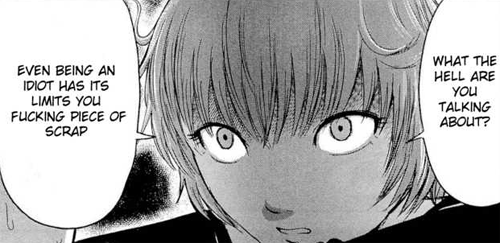
Nakamura is neither a classic tsundere nor just a "mad-girl" she's someone who sees the hypocrisy of the town and the school with brutal clarity, and refuses to live under that ceiling of daily lies/ the problem is that she has no gentle reasonable language to express this, so she falls back on violence and humiliation (blackmail)
From the moment she catches Kasuga in the act of stealing Saeki’s clothes, she decides to turn him into a "project" ;a puppet she'll drag into the deepest filth possible forcing him to confront himself stripped of the masks of "good student" and "cultured reader"
Her famous claim that humans are nothing but “shit-eaters” isn't just shallow pessimism It's the distilled result of watching everyone around her: each person carries something sick inside yet all cling desperately to the appearance of cleanliness.
In that sense, Nakamura isn't a demon attacking from the outside but a manifestation of Kasuga’s own darkness/the part of him that resonates with Baudelaire’s celebration of ugliness, corruption and desire as integral parts of human experience
Saeki and Tokiwa: The Fragility of the Ideal Image Saeki, the "perfect girl," isn't a pure angelic figure but she's also a prisoner of the image others impose on her: the smart, calm and pure student adored by everyone blah blah blah..
When her image is cracked by the revelation of Kasuga and Nakamura’s relationship, her inner layers start to surface Saeki too, has her own desires, selfish impulses, and need for control shemoves uneasily between jealousy and curiosity between wanting to save Kasuga and wanting to possess him
In the second part of the manga, Tokiwa appears as a radically different alternative: a girl who reads// writes, and shares Kasuga’s love for literature, but in a more grounded and mature way but with Tokiwa, Kasuga tries for the first time to build a ''normal" relationship one that doesn't revolve around deviance and blackmail, but around mutual recognition of weakness and common interests...so basically this manga seems to suggest that growing up means finding someone who can see your dirt and neither worship you nor despise you for it

Adolescence as a FLOWER >> :
The title, borrowed from Baudelaire, doesn’t say that "evil" is an external force that suddenly invades society. It's the flower that blooms inside everyone especially people during their teenagehood when they first collide with their own contradictions: body versus soul, desire versus morality and fantasy versus reality
Each character in Aku no Hana carries their own version of this flower:
Kasuga tries to cover his sexual urges with culture and literature, and ends up torn between the two
Nakamura turns her hatred of hypocrisy into a project of self-destruction that drags others down with her (nakamura is trying to live the literature not just performating it as kasuga used to do)
Saeki suffocates inside the role of the “perfect girl” until she is on the verge of bursting
Tokiwa tries to sublimate this inner evil into writing and quieter forms of expression (accurate literature of evil by bataille)
Adolescence here is not just an age range, but a dangerous crossing point between supposed innocence and inevitable corruption. The manga refuses to offer easy moral resolutions. It never gives Kasuga a simple "redemption arc" in a religious sense; instead, it lets him learn how to live with what he has done, to accept that all of it is part of who he's
And one of the inonic scenes I saw is the one about the destruction of the classroom, where Kasuga and Nakamura unleash all their pent-up chaos by smashing and defiling the room a childish, almost ritual rebellion against the school system and everything itsymbolizes
This explosion isn't just random anarchy. It's a visual embodiment of the idea that the filth inside eventually has to spill out..the "flower of evil" cannot remain a private, invisible growth inside the body; it needs to leave a mark on the material world
And one when the years passed when Kasuga returns to face Nakamura by the sea, the tone flips completely: no visual chaos, just a wide emptiness, an open shore, and a heavy silence...their physical struggle, the embrace, the collapse all of these are moments of delayed purification. It is one last burst of violence that allows them to silently admit that they went through that hell together; that running from the past does not erase it, only turns it into a ghost that follows you until you turn around and face it (and the ghost in this case is nakamura)

